
How to Get Free Crypto
Simple tricks to build a profitable portfolio at zero cost
XLM Overview
- Our real-time XLM to USD price update shows the current Stellar price as $0.17 USD.
- Our most recent Stellar price forecast indicates that its value will increase by 1.21% and reach $0.17 by March 23, 2026.
- Our technical indicators signal about the bearish Bullish 22% market sentiment on Stellar, while the Fear & Greed Index is displaying a score of 11 (Extreme Fear).
- Over the last 30 days, Stellar has had 13/30 (43%) green days and 4.12% price volatility.
Stellar Profit Calculator
Profit calculation please wait…
Stellar (XLM) Technical Overview
When discussing future trading opportunities of digital assets, it is essential to pay attention to market sentiments.
The bulls are fading – sell and lock in your gains!
On the four-hour chart, Stellar is bullish. The 50-day moving average is rising, suggesting a strong short-term trend. Meanwhile, the 200-day moving average has been rising since 17/03/2026, indicating a strong longer-term trend.
In the daily chart, Stellar is bearish. The 50-day moving average, currently below the price, is falling, which might support future price movements. The 200-day moving average has been falling since 19/02/2026, showing long-term weakness.
On the weekly timeframe, Stellar appears bearish. The 50-day moving average is above the price and falling, potentially acting as resistance. The 200-day moving average, rising since 31/08/2025, supports a sustained trend.
Stellar (XLM) Price Prediction For Today, Tomorrow and Next 30 Days
| Date | Price | Change |
|---|---|---|
| March 21, 2026 | 0.166 | -0.59% |
| March 22, 2026 | 0.167 | 0.01% |
| March 23, 2026 | 0.169 | 1.21% |
| March 24, 2026 | 0.17 | 1.81% |
| March 25, 2026 | 0.17 | 1.81% |
| March 26, 2026 | 0.17 | 1.81% |
| March 27, 2026 | 0.17 | 1.81% |
| March 28, 2026 | 0.17 | 1.81% |
| March 29, 2026 | 0.169 | 1.21% |
| March 30, 2026 | 0.169 | 1.21% |
| March 31, 2026 | 0.17 | 1.81% |
| April 01, 2026 | 0.173 | 3.61% |
| April 02, 2026 | 0.174 | 4.21% |
| April 03, 2026 | 0.174 | 4.21% |
| April 04, 2026 | 0.178 | 6.6% |
| April 05, 2026 | 0.182 | 9% |
| April 06, 2026 | 0.182 | 9% |
| April 07, 2026 | 0.182 | 9% |
| April 08, 2026 | 0.183 | 9.6% |
| April 09, 2026 | 0.184 | 10.19% |
| April 10, 2026 | 0.185 | 10.79% |
| April 11, 2026 | 0.186 | 11.39% |
| April 12, 2026 | 0.188 | 12.59% |
| April 13, 2026 | 0.191 | 14.39% |
| April 14, 2026 | 0.196 | 17.38% |
| April 15, 2026 | 0.199 | 19.18% |
| April 16, 2026 | 0.198 | 18.58% |
| April 17, 2026 | 0.199 | 19.18% |
| April 18, 2026 | 0.201 | 20.38% |
| April 19, 2026 | 0.2 | 19.78% |
Stellar Prediction Table
2026
2027
2028
2029
2030
2031
2032
2033
2034
2035
2040
2050
| March | $0.166 | $0.170 | $0.173 | |
| April | $0.169 | $0.185 | $0.201 | |
| May | $0.157 | $0.172 | $0.187 | |
| June | $0.172 | $0.190 | $0.207 | |
| July | $0.195 | $0.206 | $0.217 | |
| August | $0.198 | $0.214 | $0.229 | |
| September | $0.208 | $0.236 | $0.263 | |
| October | $0.237 | $0.255 | $0.273 | |
| November | $0.267 | $0.292 | $0.317 | |
| December | $0.278 | $0.324 | $0.369 | |
| All Time | $0.205 | $0.224 | $0.244 |
Choose a year
2026
2027
2028
2029
2030
2031
2032
2033
2034
2035
2040
2050
Stellar Historical
According to the latest data gathered, the current price of Stellar is $0.17, and XLM is presently ranked No. 17 in the entire crypto ecosystem. The circulation supply of Stellar is 33,010,200,000 XLM, with a market cap of $5,554,400,000.00.
In the past 24 hours, the crypto has increased by $0.0008 in its current value.
For the last 7 days, XLM has been in a good upward trend, thus increasing by 2.67%. Stellar has shown very strong potential lately, and this could be a good opportunity to dig right in and invest.
Within the last month, the price of XLM has decreased by 0.04%, eliminating a whopping average sum of $0.00007 from its current value. This sudden drop means that the coin is in a dip right now, so it can be a good buying opportunity for quick investment.
Stellar Price Prediction 2026
According to the technical analysis of Stellar prices expected in 2026, the minimum cost of Stellar will be $0.157. The maximum level that the XLM price can reach is $0.201. The average trading price is expected around $0.179.
XLM Price Forecast for March 2026
Market analysts predict that Stellar will not fall below $0.166 in March 2026, with a chance of peaking at $0.173 in the same month. The average trading value is expected to be $0.170.
April 2026: Stellar Price Forecast
Cryptocurrency experts are ready to announce their forecast for the XLM price in April 2026. The minimum trading cost might be $0.169, while the maximum might reach $0.201 during this month. On average, it is expected that the value of Stellar might be around $0.185.
XLM Price Forecast for May 2026
Crypto analysts have checked the price fluctuations of Stellar in 2026 and in previous years, so the average XLM rate they predict might be around $0.172 in May 2026. It can drop to $0.157 as a minimum. The maximum value might be $0.187.
June 2026: Stellar Price Forecast
In the middle of the year 2026, the XLM price will be traded at $0.190 on average. June 2026 might also witness an increase in the Stellar value to $0.207. It is assumed that the price will not drop lower than $0.172 in June 2026.
XLM Price Forecast for July 2026
Crypto experts have analyzed Stellar prices in 2026, so they are ready to provide their estimated trading average for July 2026 — $0.206. The lowest and peak XLM rates might be $0.195 and $0.217.
August 2026: Stellar Price Forecast
Crypto analysts expect that at the end of summer 2026, the XLM price will be around $0.214. In August 2026, the Stellar cost may drop to a minimum of $0.198. The expected peak value might be $0.229 in August 2026.
XLM Price Forecast for September 2026
Having analyzed Stellar prices, cryptocurrency experts expect that the XLM rate might reach a maximum of $0.263 in September 2026. It might, however, drop to $0.208. For September 2026, the forecasted average of Stellar is nearly $0.236.
October 2026: Stellar Price Forecast
In the middle of autumn 2026, the Stellar cost will be traded at the average level of $0.255. Crypto analysts expect that in October 2026, the XLM price might fluctuate between $0.237 and $0.273.
XLM Price Forecast for November 2026
Market experts expect that in November 2026, the Stellar value will not drop below a minimum of $0.267. The maximum peak expected this month is $0.317. The estimated average trading value will be at the level of $0.292.
December 2026: Stellar Price Forecast
Cryptocurrency experts have carefully analyzed the range of XLM prices throughout 2026. For December 2026, their forecast is the following: the maximum trading value of Stellar will be around $0.369, with a possibility of dropping to a minimum of $0.278. In December 2026, the average cost will be $0.324.
Stellar Price Prediction 2027
After the analysis of the prices of Stellar in previous years, it is assumed that in 2027, the minimum price of Stellar will be around $0.179. The maximum expected XLM price may be around $0.369. On average, the trading price might be $0.265 in 2027.
| Month | Minimum Price | Average Price | Maximum Price |
|---|---|---|---|
| January 2027 | $0.159 | $0.186 | $0.215 |
| February 2027 | $0.161 | $0.193 | $0.229 |
| March 2027 | $0.163 | $0.201 | $0.243 |
| April 2027 | $0.164 | $0.208 | $0.257 |
| May 2027 | $0.166 | $0.215 | $0.271 |
| June 2027 | $0.168 | $0.222 | $0.285 |
| July 2027 | $0.170 | $0.229 | $0.299 |
| August 2027 | $0.172 | $0.236 | $0.313 |
| September 2027 | $0.174 | $0.244 | $0.327 |
| October 2027 | $0.175 | $0.251 | $0.341 |
| November 2027 | $0.177 | $0.258 | $0.355 |
| December 2027 | $0.179 | $0.265 | $0.369 |
Stellar Price Prediction 2028
Based on the technical analysis by cryptocurrency experts regarding the prices of Stellar, in 2028, XLM is expected to have the following minimum and maximum prices: about $0.209 and $0.336, respectively. The average expected trading cost is $0.265.
| Month | Minimum Price | Average Price | Maximum Price |
|---|---|---|---|
| January 2028 | $0.182 | $0.265 | $0.366 |
| February 2028 | $0.184 | $0.265 | $0.364 |
| March 2028 | $0.187 | $0.265 | $0.361 |
| April 2028 | $0.189 | $0.265 | $0.358 |
| May 2028 | $0.192 | $0.265 | $0.355 |
| June 2028 | $0.194 | $0.265 | $0.353 |
| July 2028 | $0.197 | $0.265 | $0.350 |
| August 2028 | $0.199 | $0.265 | $0.347 |
| September 2028 | $0.202 | $0.265 | $0.344 |
| October 2028 | $0.204 | $0.265 | $0.342 |
| November 2028 | $0.207 | $0.265 | $0.339 |
| December 2028 | $0.209 | $0.265 | $0.336 |
Stellar Price Prediction 2029
The experts in the field of cryptocurrency have analyzed the prices of Stellar and their fluctuations during the previous years. It is assumed that in 2029, the minimum XLM price might drop to $0.192, while its maximum can reach $0.499. On average, the trading cost will be around $0.281.
| Month | Minimum Price | Average Price | Maximum Price |
|---|---|---|---|
| January 2029 | $0.208 | $0.266 | $0.350 |
| February 2029 | $0.206 | $0.268 | $0.363 |
| March 2029 | $0.205 | $0.269 | $0.377 |
| April 2029 | $0.203 | $0.270 | $0.390 |
| May 2029 | $0.202 | $0.272 | $0.404 |
| June 2029 | $0.201 | $0.273 | $0.418 |
| July 2029 | $0.199 | $0.274 | $0.431 |
| August 2029 | $0.198 | $0.276 | $0.445 |
| September 2029 | $0.196 | $0.277 | $0.458 |
| October 2029 | $0.195 | $0.278 | $0.472 |
| November 2029 | $0.193 | $0.280 | $0.485 |
| December 2029 | $0.192 | $0.281 | $0.499 |
Stellar Price Prediction 2030
Based on the analysis of the costs of Stellar by crypto experts, the following maximum and minimum XLM prices are expected in 2030: $0.400 and $0.334. On average, it will be traded at $0.379.
| Month | Minimum Price | Average Price | Maximum Price |
|---|---|---|---|
| January 2030 | $0.204 | $0.289 | $0.491 |
| February 2030 | $0.216 | $0.297 | $0.483 |
| March 2030 | $0.228 | $0.306 | $0.474 |
| April 2030 | $0.239 | $0.314 | $0.466 |
| May 2030 | $0.251 | $0.322 | $0.458 |
| June 2030 | $0.263 | $0.330 | $0.450 |
| July 2030 | $0.275 | $0.338 | $0.441 |
| August 2030 | $0.287 | $0.346 | $0.433 |
| September 2030 | $0.299 | $0.355 | $0.425 |
| October 2030 | $0.310 | $0.363 | $0.417 |
| November 2030 | $0.322 | $0.371 | $0.408 |
| December 2030 | $0.334 | $0.379 | $0.400 |
Stellar Price Prediction 2031
Crypto experts are constantly analyzing the fluctuations of Stellar. Based on their predictions, the estimated average XLM price will be around $0.406. It might drop to a minimum of $0.375, but it still might reach $0.444 throughout 2031.
| Month | Minimum Price | Average Price | Maximum Price |
|---|---|---|---|
| January 2031 | $0.337 | $0.381 | $0.404 |
| February 2031 | $0.341 | $0.384 | $0.407 |
| March 2031 | $0.344 | $0.386 | $0.411 |
| April 2031 | $0.348 | $0.388 | $0.415 |
| May 2031 | $0.351 | $0.390 | $0.418 |
| June 2031 | $0.355 | $0.393 | $0.422 |
| July 2031 | $0.358 | $0.395 | $0.426 |
| August 2031 | $0.361 | $0.397 | $0.429 |
| September 2031 | $0.365 | $0.399 | $0.433 |
| October 2031 | $0.368 | $0.402 | $0.437 |
| November 2031 | $0.372 | $0.404 | $0.440 |
| December 2031 | $0.375 | $0.406 | $0.444 |
Stellar Price Prediction 2032
Every year, cryptocurrency experts prepare forecasts for the price of Stellar. It is estimated that XLM will be traded between $0.383 and $0.432 in 2032. Its average cost is expected at around $0.406 during the year.
| Month | Minimum Price | Average Price | Maximum Price |
|---|---|---|---|
| January 2032 | $0.376 | $0.406 | $0.443 |
| February 2032 | $0.376 | $0.406 | $0.442 |
| March 2032 | $0.377 | $0.406 | $0.441 |
| April 2032 | $0.378 | $0.406 | $0.440 |
| May 2032 | $0.378 | $0.406 | $0.439 |
| June 2032 | $0.379 | $0.406 | $0.438 |
| July 2032 | $0.380 | $0.406 | $0.437 |
| August 2032 | $0.380 | $0.406 | $0.436 |
| September 2032 | $0.381 | $0.406 | $0.435 |
| October 2032 | $0.382 | $0.406 | $0.434 |
| November 2032 | $0.382 | $0.406 | $0.433 |
| December 2032 | $0.383 | $0.406 | $0.432 |
Stellar Price Prediction 2033
Cryptocurrency analysts are ready to announce their estimations of the Stellar’s price. The year 2033 will be determined by the maximum XLM price of $0.491. However, its rate might drop to around $0.379. So, the expected average trading price is $0.412.
| Month | Minimum Price | Average Price | Maximum Price |
|---|---|---|---|
| January 2033 | $0.383 | $0.407 | $0.437 |
| February 2033 | $0.382 | $0.407 | $0.442 |
| March 2033 | $0.382 | $0.408 | $0.447 |
| April 2033 | $0.382 | $0.408 | $0.452 |
| May 2033 | $0.381 | $0.409 | $0.457 |
| June 2033 | $0.381 | $0.409 | $0.462 |
| July 2033 | $0.381 | $0.410 | $0.466 |
| August 2033 | $0.380 | $0.410 | $0.471 |
| September 2033 | $0.380 | $0.411 | $0.476 |
| October 2033 | $0.380 | $0.411 | $0.481 |
| November 2033 | $0.379 | $0.412 | $0.486 |
| December 2033 | $0.379 | $0.412 | $0.491 |
Stellar Price Prediction 2034
After years of analysis of the Stellar price, crypto experts are ready to provide their XLM cost estimation for 2034. It will be traded for at least $0.431, with the possible maximum peaks at $0.480. Therefore, on average, you can expect the XLM price to be around $0.457 in 2034.
| Month | Minimum Price | Average Price | Maximum Price |
|---|---|---|---|
| January 2034 | $0.383 | $0.416 | $0.490 |
| February 2034 | $0.388 | $0.420 | $0.489 |
| March 2034 | $0.392 | $0.423 | $0.488 |
| April 2034 | $0.396 | $0.427 | $0.487 |
| May 2034 | $0.401 | $0.431 | $0.486 |
| June 2034 | $0.405 | $0.435 | $0.486 |
| July 2034 | $0.409 | $0.438 | $0.485 |
| August 2034 | $0.414 | $0.442 | $0.484 |
| September 2034 | $0.418 | $0.446 | $0.483 |
| October 2034 | $0.422 | $0.450 | $0.482 |
| November 2034 | $0.427 | $0.453 | $0.481 |
| December 2034 | $0.431 | $0.457 | $0.480 |
Stellar Price Prediction 2035
Cryptocurrency analysts are ready to announce their estimations of the Stellar’s price. The year 2035 will be determined by the maximum XLM price of $0.532. However, its rate might drop to around $0.450. So, the expected average trading price is $0.487.
| Month | Minimum Price | Average Price | Maximum Price |
|---|---|---|---|
| January 2035 | $0.433 | $0.460 | $0.484 |
| February 2035 | $0.434 | $0.462 | $0.489 |
| March 2035 | $0.436 | $0.465 | $0.493 |
| April 2035 | $0.437 | $0.467 | $0.497 |
| May 2035 | $0.439 | $0.470 | $0.502 |
| June 2035 | $0.441 | $0.472 | $0.506 |
| July 2035 | $0.442 | $0.475 | $0.510 |
| August 2035 | $0.444 | $0.477 | $0.515 |
| September 2035 | $0.445 | $0.480 | $0.519 |
| October 2035 | $0.447 | $0.482 | $0.523 |
| November 2035 | $0.448 | $0.485 | $0.528 |
| December 2035 | $0.450 | $0.487 | $0.532 |
Stellar Price Prediction 2040
Cryptocurrency analysts are ready to announce their estimations of the Stellar’s price. The year 2040 will be determined by the maximum XLM price of $0.621. However, its rate might drop to around $0.551. So, the expected average trading price is $0.584.
| Month | Minimum Price | Average Price | Maximum Price |
|---|---|---|---|
| January 2040 | $0.458 | $0.495 | $0.539 |
| February 2040 | $0.467 | $0.503 | $0.547 |
| March 2040 | $0.475 | $0.511 | $0.554 |
| April 2040 | $0.484 | $0.519 | $0.562 |
| May 2040 | $0.492 | $0.527 | $0.569 |
| June 2040 | $0.501 | $0.536 | $0.577 |
| July 2040 | $0.509 | $0.544 | $0.584 |
| August 2040 | $0.517 | $0.552 | $0.591 |
| September 2040 | $0.526 | $0.560 | $0.599 |
| October 2040 | $0.534 | $0.568 | $0.606 |
| November 2040 | $0.543 | $0.576 | $0.614 |
| December 2040 | $0.551 | $0.584 | $0.621 |
Stellar Price Prediction 2050
Cryptocurrency analysts are ready to announce their estimations of the Stellar’s price. The year 2050 will be determined by the maximum XLM price of $0.992. However, its rate might drop to around $0.892. So, the expected average trading price is $0.947.
| Month | Minimum Price | Average Price | Maximum Price |
|---|---|---|---|
| January 2050 | $0.579 | $0.614 | $0.652 |
| February 2050 | $0.608 | $0.645 | $0.683 |
| March 2050 | $0.636 | $0.675 | $0.714 |
| April 2050 | $0.665 | $0.705 | $0.745 |
| May 2050 | $0.693 | $0.735 | $0.776 |
| June 2050 | $0.722 | $0.766 | $0.807 |
| July 2050 | $0.750 | $0.796 | $0.837 |
| August 2050 | $0.778 | $0.826 | $0.868 |
| September 2050 | $0.807 | $0.856 | $0.899 |
| October 2050 | $0.835 | $0.887 | $0.930 |
| November 2050 | $0.864 | $0.917 | $0.961 |
| December 2050 | $0.892 | $0.947 | $0.992 |
What Is Stellar Lumens (XLM)?
Stellar Lumens (XLM) is the native digital asset of the Stellar network, a decentralized blockchain built specifically for fast, low-cost payments and asset transfers across borders. XLM exists as the core currency that’s part of the network itself, and doesn’t depend on any issuer. It plays a fundamental role in keeping the system running smoothly by being used to pay transaction fees and enforce minimum account balances, which in turn helps prevent spam and ensures the network remains efficient and secure.
Stellar was created in 2014 by Jed McCaleb (co-founder of Ripple) and Joyce Kim, with support from the Stellar Development Foundation, with the main goal of making financial systems more open and accessible—especially for cross-border payments, remittances, and connecting traditional financial institutions with blockchain infrastructure. So instead of replacing money, Stellar focuses on moving value easily between different currencies and systems, where anchors act as bridges between real-world assets and digital representations on the network.
At a technical level, Stellar operates using the Stellar Consensus Protocol (SCP), which is based on a Federated Byzantine Agreement model, meaning validator nodes participate in consensus by selecting trusted peers (quorum slices), and these overlapping trust groups create a system where agreement can be reached quickly without energy-intensive mining, leading to fast settlement times (typically a few seconds) and relatively low resource usage compared to proof-of-work systems.
Stellar originally created 100 billion lumens at launch, but in 2019 the Stellar Development Foundation permanently burned about 50 billion XLM, reducing the total supply to roughly 50 billion with no ongoing inflation mechanism. Today, a large portion is in circulation while the rest is held for ecosystem development, which makes XLM a fixed-supply asset in practice, unlike inflationary cryptocurrencies.
Within the network, XLM connects multiple components: transactions contain operations that require small fees paid in lumens, accounts must hold a minimum balance in XLM based on a base reserve to exist, issued assets depend on issuers and trustlines while XLM does not, and more advanced features like path payments use the built-in decentralized exchange and liquidity pools to convert between different assets seamlessly, meaning XLM often acts as a bridge asset in multi-currency transfers.
From a practical perspective, XLM’s value proposition comes from utility rather than scarcity alone. It enables payments, supports liquidity, and acts as a universal intermediary in the system, so demand for XLM tends to grow when network usage increases—such as more transactions, more anchors, or more asset transfers. Its price is also influenced by broader crypto market trends, investor sentiment, and speculation. This means that although its utility creates baseline demand, its market price can still be volatile and influenced by external factors like macro conditions, regulation, and overall adoption of blockchain payments.

How to Get Free Crypto
Simple tricks to build a profitable portfolio at zero cost

What Factors Affect the XLM Price?
- Bitcoin market cycles and altcoin sentiment. Like nearly all altcoins, XLM follows Bitcoin’s macro rhythm with amplified volatility in both directions. XLM has no staking yield, no DeFi-native demand, and no independent supply reduction mechanism, making the broader crypto cycle its dominant short-term price driver.
- Cross-border payment adoption and network usage. XLM’s core utility is as a bridge currency for international transfers, settling in 3 to 5 seconds at a fraction of a cent. Real demand for XLM is directly tied to value flowing through Stellar’s payment corridors. Rising transaction volume and active wallet counts drive genuine utility-based price support independent of speculation.
- Institutional partnerships and financial infrastructure. Stellar’s price is unusually sensitive to enterprise announcements. Partnerships with MoneyGram, Visa, Paxos, Ondo, Franklin Templeton, and WisdomTree collectively drove over $757 million in real-world asset tokenization on the network by Q1 2025, with the SDF targeting $3 billion by year-end. Each new institutional anchor that settles payments or tokenizes assets on Stellar creates direct demand for XLM.
- DTCC securities settlement designation. One of the most significant near-term catalysts in XLM’s history is still pending confirmation. The Depository Trust Company plans to launch a tokenization service in H2 2026, and a related patent identifies XLM as a designated Digital Liquidity Token for facilitating cross-ledger settlement within its framework. If confirmed at scale, this positions XLM at the center of a multi-trillion dollar institutional settlement system.
- Fixed supply and the 2019 burn event. In November 2019, the Stellar Development Foundation burned over 50 billion XLM, reducing total supply from over 100 billion to approximately 50 billion. The 1% annual inflation mechanism was simultaneously deprecated by validator vote, making XLM’s supply permanently fixed. With over 30 billion XLM currently in circulation, no new tokens can ever be created, structurally supporting long-term scarcity.
- Stellar Development Foundation treasury management. The SDF holds the remainder of the post-burn supply for ecosystem development and grants, originally approximately 30 billion XLM, with holdings declining over time as funds are deployed per its public mandate. SDF’s $100 million adoption fund currently supports over 160 projects across the Stellar ecosystem. How gradually these reserves are deployed directly affects investor confidence. Large or unexpected SDF distributions increase circulating supply and pressure price.
- Soroban smart contracts and DeFi expansion. Stellar’s original design focused purely on payments, but Soroban has opened a new growth vector. Protocol 23 upgrades enhanced Soroban smart contracts for decentralized applications, stablecoins including USDC with a monthly volume of $500 million, and tokenized treasuries, with Stellar ranking second in that category at $470 million. DeFi growth on Stellar creates fee-generating XLM demand that payments alone cannot produce.
- ISO 20022 compliance and banking interoperability. XLM is one of a small number of crypto assets natively compatible with ISO 20022, the global messaging standard being adopted by SWIFT and major central banks. This makes XLM one of the few crypto assets with the potential to sit at the intersection of traditional banking systems and decentralized finance. As institutions upgrade to ISO 20022-compliant infrastructure, Stellar’s built-in compatibility becomes a structural competitive advantage over rivals.
- Competition from XRP, CBDCs, and rival chains. XLM’s primary competitor is XRP, targeting the same institutional cross-border payments market with a larger network effect and deeper banking partnerships. Central bank digital currencies (CBDCs) represent an existential longer-term threat—if major economies deploy them for cross-border settlement, demand for a third-party bridge currency like XLM could diminish. Newer Layer 1 blockchains adding payment functionality also dilute XLM’s positioning.
- Regulatory environment for payment tokens and stablecoins. XLM sits at the intersection of two regulatory battlegrounds: cross-border payments and stablecoin issuance. The EU’s MiCA framework, US stablecoin legislation, and CBDC policy all directly affect whether financial institutions can deploy Stellar-based products at scale. Favorable clarity accelerates institutional adoption pipelines; restrictive rulings can freeze deals already in negotiation.
- Real-world asset tokenization momentum. US Treasury bonds dominate Stellar’s RWA ecosystem at 94.8% of total value, led by Franklin Templeton’s BENJI token with a $496 million market cap, followed by WisdomTree’s tokenized funds, Ondo Finance’s USDY, and Mercado Bitcoin’s $200 million in tokenized fixed income and equity instruments. The pace at which asset managers bring additional asset classes on-chain on Stellar is now a primary long-term fundamental driver alongside payment volume.
- Macroeconomic conditions and emerging market demand. Rate cuts and looser monetary policy historically push capital toward risk assets including XLM. Conversely, emerging market currency volatility often drives demand for fast, cheap cross-border settlement, which can benefit XLM’s utility demand even in broader risk-off environments—a rare split between speculative price and fundamental usage that defines Stellar’s unique macro profile.
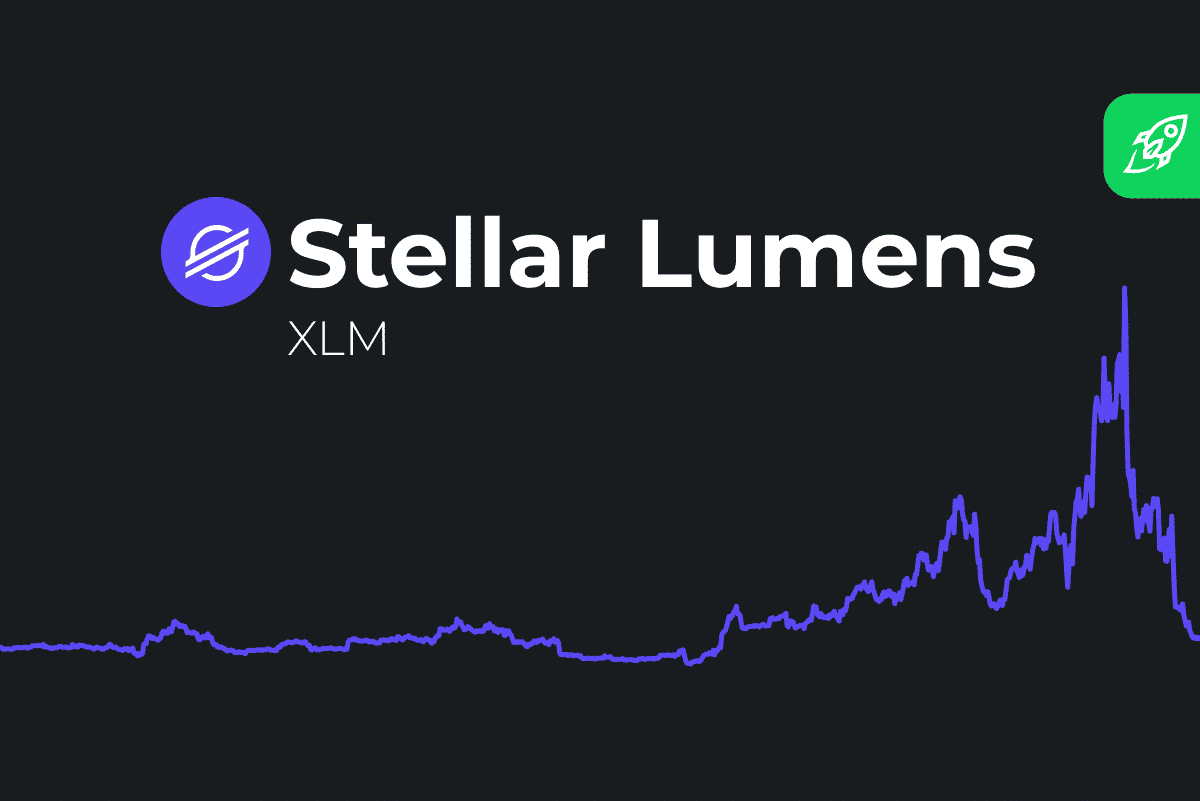
Stellar Lumens (XLM) Price History
- 2014–2016, obscure launch with no catalysts: ATL $0.0012, closed $0.002. XLM launched at fractions of a cent and spent two years in near-total obscurity. The all-time low of $0.0012 was recorded in November 2014. The token was renamed from “Stellar” to “Lumens” in 2015 to avoid confusion between the network and its currency. Price drifted between $0.001 and $0.004, closing 2016 around $0.002 with no major catalysts.
- 2017, IBM partnership fuels best-ever annual gain: $0.0025 to $0.36. XLM’s best-ever annual performance. The ICO boom lifted the entire crypto market and Stellar benefited disproportionately from a landmark partnership with IBM to build Blockchain World Wire, a cross-border payment network launched in 2019, covering 72 countries and 48 currencies. XLM gained 14,463% across 2017, opening at $0.0025 and closing at $0.36. The IBM deal was the first credible proof that a major institution viewed Stellar as viable payment infrastructure.
- 2018, bubble peak then sector-wide collapse: ATH $0.9381 to $0.11. The bubble peak carried XLM to its all-time high of $0.9381 on January 4. The collapse was swift and total, with XLM closing the year at approximately $0.11, losing roughly 88% from peak. No enterprise partnership could protect it from the sector-wide rout that erased hundreds of billions in crypto market cap.
- 2019, supply burn fails to stop the bleed: closed $0.042. A slow bleed followed by the most consequential decision in XLM’s history. In November 2019, the SDF burned over 50 billion XLM, cutting total supply from ~100 billion to approximately 50 billion and deprecating the 1% annual inflation mechanism by validator vote, making supply permanently fixed. XLM closed the year near $0.042. The burn was received positively but failed to arrest the price decline.
- 2020, stimulus and remittance growth drive recovery: $0.038 to $0.18. The Fed stimulus and DeFi Summer lifted all crypto assets. XLM rose from $0.038 to $0.12 by August as institutional interest in blockchain remittances grew, with MoneyGram deepening its Stellar integration. XLM closed 2020 near $0.18, up roughly 375% from its January low.
- 2021, post-2018 peak then second-half fade: $0.18 to peak $0.79, closed $0.29. XLM reached its post-2018 peak of $0.79 in May, riding the same NFT and DeFi wave that drove Ethereum to record highs. Price declined through the second half of the year, closing 2021 at around $0.29. Franklin Templeton’s BENJI token launched on Stellar in April as the first on-chain money market fund—a milestone that would only register in investor consciousness years later.
- 2022, worst-ever annual loss: $0.267 to $0.071. The crypto winter was brutal. Terra/LUNA in May and FTX in November destroyed broad sentiment. XLM had no DeFi ecosystem or speculative community to cushion the fall. 2022 was XLM’s worst-ever annual performance, falling 73% from $0.267 to a close of $0.071.
- 2023, quiet recovery on ETF speculation: $0.071 to $0.129. A quiet recovery. XLM climbed to a high below $0.20, aided by broader Bitcoin ETF speculation and a Bitso partnership expanding Stellar’s Latin American remittance reach. The year closed at $0.129 after dropping to $0.10 in October.
- 2024, flat all year then election-driven surge: $0.10 to $0.31. Two distinct narratives. XLM drifted near $0.10 to $0.14 as Soroban’s smart contract deployment generated developer interest but limited price action. Then October brought Mastercard’s Crypto Credential partnership, Paxos confirmed PYUSD integration, and Trump’s election victory ignited the entire altcoin market. XLM surged to $0.515 in November, closing the year near $0.31, a roughly 115% annual gain driven almost entirely by the final two months.
- 2025, institutional milestones fail to move price: $0.48 to $0.21. An institutional year with a painful price correction. XLM opened near $0.48, then sold off progressively as macro fears and altcoin fatigue set in. The SDF hit its $3 billion RWA tokenization target, the network surpassed 1 billion operations in Q3, and the DTCC patent named XLM a designated settlement token. None of it produced a sustained price rally. XLM closed 2025 near $0.21, down roughly 56% from its January opening.
XLM Price Forecasts: What the Experts Say
1. CoinCodex, Algorithmic Model.
CoinCodex runs a quantitative algorithm incorporating historical volatility, Bitcoin halving cycles, and on-chain momentum. Their 2026 view is cautiously bullish in the near term but structurally constrained over the long horizon. CoinCodex forecasts XLM trading within a range of $0.168 to $0.251 across 2026, with a one-month target of $0.203 by mid-April. Their long-term ceiling is among the most conservative of all major platforms: the algorithm projects XLM reaching $1.00 only by September 2049, with the maximum ever price capped at $1.06. The model treats XLM’s dependence on institutional adoption timelines as a structural speed limiter that algorithmic price cycles cannot overcome.
2. InvestingHaven, Fibonacci and Cycle Analysis.
InvestingHaven uses Fibonacci retracement mapping, long-term cycle timing, and Bitcoin halving correlation. They sit firmly in the bullish camp for XLM’s multi-year trajectory. InvestingHaven forecasts XLM trading between $0.22 and $0.87 in 2025, with the XLM price potentially rising above $1 if adoption accelerates and major resistance levels break. For the three-year horizon, InvestingHaven projects XLM ranging between $0.91 and $1.91, with a push toward $2 possible if XLM clears the $0.71 level and institutional support deepens. The bull case is explicitly tied to the DTCC settlement designation and CME futures providing institutional infrastructure that meme-cycle demand alone could never supply.
3. Coinpedia, Fundamental Adoption Analysis.
Coinpedia uses a hybrid model combining fundamental adoption metrics with technical structure. They are the most bullish of the major platforms specifically for 2026. Coinpedia’s forecast places XLM trending toward $2.50 by 2026 if resistance above $0.50 and $1.00 is reclaimed, with a moderate scenario placing Stellar between $1.20 and $1.80. The thesis is explicitly anchored in institutional adoption velocity: If stablecoin transaction volume keeps expanding and tokenized RWA momentum continues, Stellar’s network utility may catch up to its infrastructure credentials. For 2030, Coinpedia projects XLM reaching $6.19 under favorable conditions, a target requiring Stellar to win a meaningful CBDC settlement share and DeFi traction through Soroban.
4. Cryptopolitan, Fundamental and Technical Hybrid.
Cryptopolitan combines on-chain data, roadmap analysis, and technical charting. Their view is modestly constructive near-term and progressively bullish long-term, representing a realistic middle-ground consensus. Cryptopolitan projects XLM trading between $0.134 and $0.188 in March 2026, with an average price around $0.160, reflecting continued consolidation before any structural reversal. Longer term, they project XLM ranging between $0.477 and $0.566 in 2028, building toward a potential high of $1.16 by 2032, contingent on Stellar maintaining relevance in cross-border payments and expanding DeFi activity through Soroban.
5. DigitalCoinPrice, Statistical Technical Model.
DigitalCoinPrice applies SMA-based statistical modelling updated from real-time data. Their view is a step more bullish than CoinCodex but less aggressive than InvestingHaven or Coinpedia. DigitalCoinPrice projects XLM reaching $0.32 by end of 2026, rising to $0.37 by end of 2027, with the 200-day SMA trajectory providing the structural roadmap. Their long-term ceiling is notably conservative: they project XLM reaching $0.54 by 2032 and $1.00 as a minimum only by 2040, treating Stellar as a slow-compounding infrastructure asset rather than a narrative-driven rally candidate.
6. CoinLore, Cycle-Based Statistical Model.
CoinLore uses historical price cycle analysis, RSI, MACD, Fibonacci levels, and trend momentum with manual review overlays. They produce the most aggressive bull case of any credible platform currently tracking XLM and stand as the sharpest counterpoint to CoinCodex’s structurally pessimistic long-term ceiling. CoinLore’s 2026 forecast places XLM in a range of $0.50 to $1.69, with $1.69 as their maximum cycle target for the year. For the longer term, their 2030 projection puts XLM reaching $3.26, which would represent more than 20 times current price and 3.48 times higher than its all-time high. The model is explicitly cycle-driven: it assumes the institutional infrastructure now being built around Stellar translates into a price re-rating during the next broad crypto bull cycle comparable in magnitude to previous XLM bull runs.
Disclaimer: Please note that the contents of this article are not financial or investing advice. The information provided in this article is the author’s opinion only and should not be considered as offering trading or investing recommendations. We do not make any warranties about the completeness, reliability and accuracy of this information. The cryptocurrency market suffers from high volatility and occasional arbitrary movements. Any investor, trader, or regular crypto users should research multiple viewpoints and be familiar with all local regulations before committing to an investment.
The content published on Finance Insider Today is for informational and educational purposes only. It does not constitute financial advice, investment advice, or any other form of professional advice. Always conduct your own research and consult a qualified financial advisor before making any investment decisions. Finance Insider Today is not responsible for any financial losses resulting from decisions made based on information published on this website. Past performance is not indicative of future results. Financial markets carry significant risk. Never invest more than you can afford to lose.
