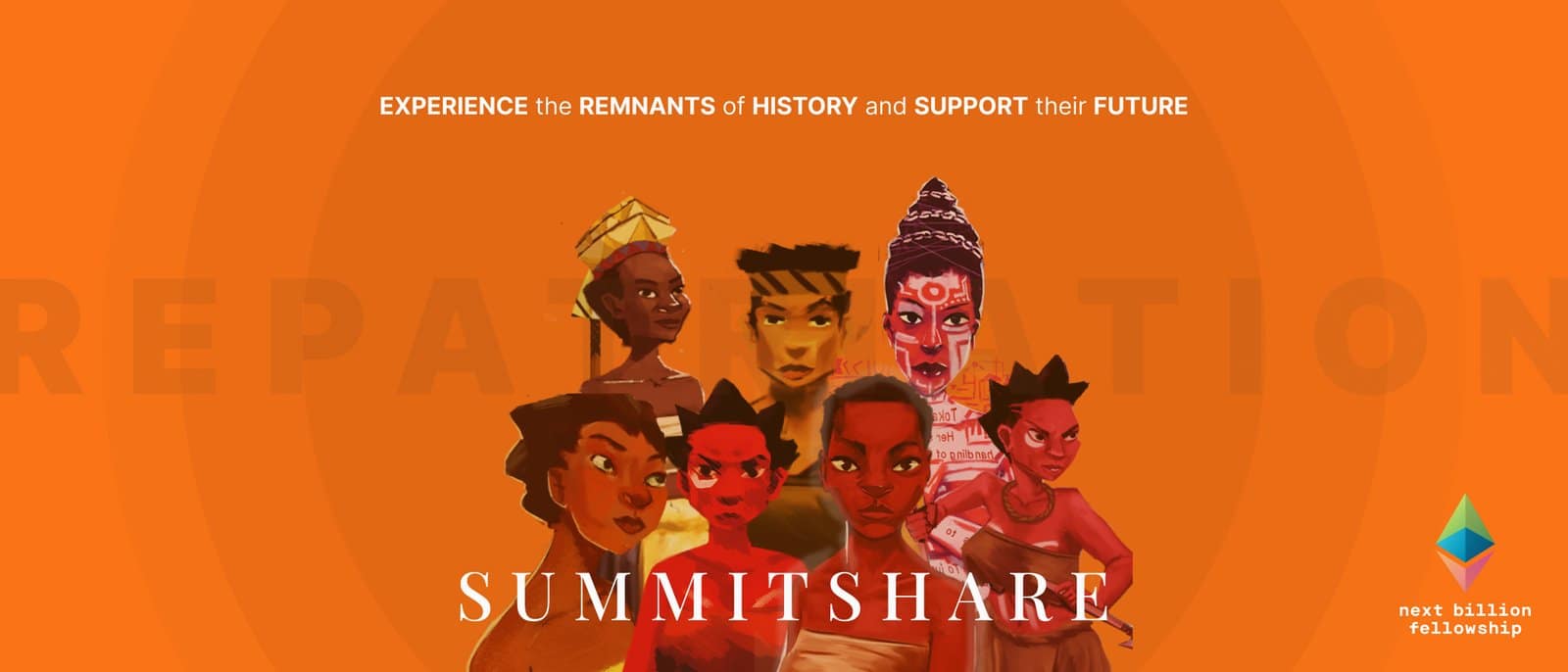

The following is an update from Next Billion Fellow Mulenga Kapwepwe and her initiative “Summitshare”. For more about the Next Billion Fellowship Program and to apply, please visit https://nxbn.ethereum.foundation/.
Mulenga Kapwepwe, founder of the Women’s History Museum of Zambia posed a question in 2022 to a small group of younger tech enthusiasts in Zambia: Can something called “blockchain technology” offer any new usefulness for the preservation of history? She had started a new initiative aimed at digital humanities, and engaging with young people excited by technology who might want to apply their talents to the world of arts, culture, and history. The group of developers, designers, and artists she was working with shared their enthusiasm for “web3”, and together they discussed some of the properties and features of blockchains. So she began to consider how they might apply it to a truly challenging problem for African Heritage: artifact repatriation.
Historically, many regions around the world have seen their material cultural heritage housed in European and American museums, raising complex questions about ownership, history, and identity. In the African context, this issue is particularly pronounced: an estimated 90% of Africa’s material cultural heritage is now located in the West, according to the 2018 Sarr and Savoy report The Restitution of African Cultural Heritage: Toward a New Relational Ethics1. While discussions around physical repatriation have persisted for years, geopolitical and logistical complexities often make tangible steps toward resolution difficult.
The group had an idea: if the physical repatriation of artifacts is too bound up in geopolitical, cultural and logistical challenges, perhaps it would be possible to create a digital cast of the artifacts as a viable alternative. By linking a digital artifact to its physical original, this method might capture and evoke a similar connection to heritage, creativity, history, and the invaluable knowledge and lessons of the past that museum patrons experience in person, while also offering a new perspective on the physical artifacts—forming innovative ways to connect with cultural heritage. With the right supporting technology, African artifacts currently locked away in European and American museums could become accessible to Africans whose ancestors took part in creating them.
Virtual and augmented reality technology has advanced enough to enable high-fidelity scans of physical objects, allowing them to be displayed on screens, projectors, or VR goggles in a museum exhibition. However, the scanned objects still need that essential property of uniqueness in order to have a meaningful sense of provenance connected to the real thing. If artifacts housed in distant museums could be scanned, minted, and exhibited as unique, provenance-verified digital items, researchers, curators, and museum patrons could engage with the artifacts in new ways. Moreover, social coordination around these digital artifacts could enable meaningful interactions, allowing communities and experts to collectively manage, share, and research cultural heritage in new ways.
Imagine ticket revenue from an exhibition on southern African masks in Brussels (or Paris, or London) directly benefiting communities in Lusaka (or Harare, or Pretoria)—communities with real, tangible connections to the artifacts. For many community members who may never have the opportunity to see the objects in person, this digital access could allow them to contribute personal memories or unique cultural context that researchers and anthropologists may have never known. Such contributions could help “recontextualize” these artifacts, restoring meaning and relevance to items that have often been displayed without the voices and perspectives of those most closely connected to them.
Through the sparks of curiosity that began with this question, the team laid the first foundational blocks of a new approach to cultural preservation: one that connects the heritage of the past with the technology of the present, bringing it to those who hold it most dear.
A History Machine
Venkatesh Rao, in a talk titled “bloodcoin”, described blockchains as “a history technology”. They provide a permanent, accessible medium to inscribe history on a ledger that does not fade or distort over time. This makes blockchains an ideal tool or technology for museums and anthropologists. Blockchains also happen to be an efficient way to enact “money” and other systems that function as mediums of exchange, unit(s) of account, and store(s) of value. These properties might allow blockchains to become a medium capable of “injecting history” into records of value and ownership to preserve and acknowledge narratives of historical debts and reparations.
To explore this potential, Mulenga Kapwepwe, along with Thomas Gondwe, Nhyira Amofa-Sekyi, and Mario Jere, co-founded SummitShare. Together, they set out to develop innovative, digital methods to address the complex realities of history. SummitShare’s approach emphasizes interactive, participatory, and educational experiences—bridging the past with a digitally fluent audience and providing meaningful connections to cultural heritage through modern technology.
In the same way that the internet radically transformed how information spreads, blockchains might transform how history is preserved, offering a form of temporal permanence. By creating digital representations of artifacts and inscribing their provenance — their journey through societies and time — SummitShare democratizes access to cultural heritage. Many artifacts in European museums today lack complete provenance, but living communities may hold valuable context (songs, stories, memories) that could deepen understanding and restore meaning. Digital casts of artifacts ensure this context is preserved while also enabling heritage communities to share in the benefits these objects generate.
Proof of Concept: Origins with the WHMZ
Through a collaboration facilitated by the Women’s History Museum of Zambia, the SummitShare team engaged with the Swedish Ethnographic Museum to access their catalog and digital repository of artifacts. This partnership provided SummitShare with valuable resources, including access to digital records containing provenance information and initial 3D casts of artifacts held in the Swedish museum’s collection. Leveraging these resources, the team began designing and modeling a 3D virtual exhibit featuring artifacts with rich historical contexts from Zambia and southern Africa. Beyond the digital modeling, the project also proposed tokenizing these artifacts to encode and preserve their provenance, marking a significant step toward the creation of a decentralized digital repository.
Development and Growth Under Ethereum’s Next Billion Fellowship Program
In 2023, Mulenga (as lead of the SummitShare team) joined the Ethereum Foundation’s Next Billion Fellowship Program, allowing them to refine the project. The project gained valuable open-source contributions for smart contract and initial subgraph design from a pseudonymous contributor, and from Hanan Haj Ahmed, a Palestinian designer, who contributed early work amidst significant challenges in Gaza. Daniel Tembo, a skilled 3D artist with a background in game design, serves as the architect of SummitShare’s virtual realm, and crafted virtual exhibition environments to bring artifacts to life in immersive digital format.
The Leading Ladies Exhibit: A Model for Digital and Physical Collaboration
Throughout 2024, the SummitShare team has prepared for its inaugural exhibit, furthering research on local repatriation efforts and forming key partnerships, including with the Octant Accelerator to scale the platform. This exhibit, titled Leading Ladies, focuses on the lives and artifacts of six Zambian women—trailblazers from various societal roles, such as generals, political activists, and tribal leaders. These artifacts provide unique historical insights and inspiration for modern society.
With SummitShare, museums and galleries can create exhibitions with both physical and digital elements, each connected through smart contracts. This allows for unique synergies, such as ticket sales for European exhibitions supporting cultural programs in Africa, combining digital artifacts with tangible benefits for heritage communities.
An exhibit on SummitShare is not just a set of images and models of art pieces or objects – they are linked to a set of smart contracts that provide a unique tag to the object and allow it to be represented on the internet of value. With the SummitShare smart contracts, we get the provenance and uniqueness needed for that meaningful connection to a digital item.
Moreover, the platform also uses the same set of contracts to manage ticket sales as well as interactive features of the exhibit that relate to the digitized objects. Curation fees, proceeds, benefits, and the relationship between them are all structured to return value to all custodians of heritage and cultural value, historically and geographically.
The Leading Ladies exhibit holds a special association with Zambia’s Gwembe Valley community, highlighting the cultural origins of the artifacts. The goal is to ensure that the Gwembe Valley community directly benefits from the exhibit’s proceeds and engagement.
Before launching this exhibit, the SummitShare team met with Gwembe Valley leaders to understand their preservation methods, governance, and information-sharing practices, which informed how the platform integrates traditional governance into decision-making processes.
The Gwembe Valley’s support extends to 150 communities within their jurisdiction, offering an incredible opportunity for SummitShare to reach a broad, interconnected audience.
Forward-looking History
SummitShare isn’t just about African heritage, it’s about using human coordination to solve the global issue of cultural disconnection. By placing history and culture onchain, we create an immutable record and a bridge between past and present, preserving legacies while empowering heritage communities.
At its core, SummitShare focuses on provenance (information) and people. These guiding principles drive its mission to bridge gaps in access, knowledge, and representation. This journey is one of research, experimentation, and the design of systems that enable democratized access to cultural and economic components that have long been out of reach.
The Leading Ladies Exhibit is now available for early access to supporters. If you’d like to engage with the SummitShare initiative and contribute to the Gwembe Valley community, you can learn more about the virtual exhibit and secure your access ahead of the official opening on December 13th, 2024, on the SummitShare website.
If you work in the museum, university, or cultural heritage space and would like to know more about SummitShare, or would like to collaborate on an exhibition, please contact info@summitshare.co or reach out to nextbillion@ethereum.foundation.
Together, let’s redefine cultural heritage for a connected, decentralized world—one that values shared stories and inclusive innovation.
If you’re a leader, creator, or builder working on human-centric challenges, we are looking for your story! You can now apply for Cohorts 5 & 6 of the Next Billion Fellowship. Applications for Cohort 5 will be considered until 12 January 2025
The content published on Finance Insider Today is for informational and educational purposes only. It does not constitute financial advice, investment advice, or any other form of professional advice. Always conduct your own research and consult a qualified financial advisor before making any investment decisions. Finance Insider Today is not responsible for any financial losses resulting from decisions made based on information published on this website. Past performance is not indicative of future results. Financial markets carry significant risk. Never invest more than you can afford to lose.
