

Polygon (POL) just gained mainstream traction after Mastercard named the popular Layer-2 chain in their pioneering Mastercard Crypto Partner Program. Within this new ecosystem, the blockchain infrastructure is connected to global payments.
Mastercard Eagerly Shakes Hands With Polygon
This collaborative initiative by Mastercard unites 85 crypto platforms, firms & blockchains. Due to the six-year expertise in the payment settlement field, Polygon’s (POL) participation is vital – the Layer 2 chain is processing roughly over a trillion dollars in stablecoin transactions annually, particularly USDC & USDT.
Bridging the gap between every-day payments and on-chain transaction settlement has been a hot debate ever since the Clarity Act saw the light of day. With crypto connoisseurs & banking representatives still grappling with the dilemma of stablecoin yield, the Clarity Act might face a clearer path in April, 2026.
Clarity Act Delay Got Market Watchers Hibernating
Until then, most major crypto currency holders are in a ‘wait & see’ mode, and Polygon (POL) believers are no different. Gaining institutional access, Polygon’s (POL) gets a chance at enterprise-scale adoption – a narrative often overshadowed by bigger altcoin competitors like Ripple (XRP) & Stellar (XLM).
However, a renaissance in on-chain activity has already presented itself. Particularly, Polygon’s chain fees had skyrocketed back to 2024 levels, when Polygon’s native crypto token was trading at $0.85. Right now, the popular L2 chain’s token trades at just a fraction of that price below $0.10, but the swiftly-growing multi-billion dollar stablecoin market cap paints a bright future.
Stablecoin Cap Exceeds $3.36B: No Price Reaction?
Digging deeper into these on-chain stats, DailyCoin’s research team noticed a discrepancy between Polygon’s (ex. MATIC) price & the stablecoin market cap growth. The inverse correlation between these factors has even the long-term POL holders scratching their heads.
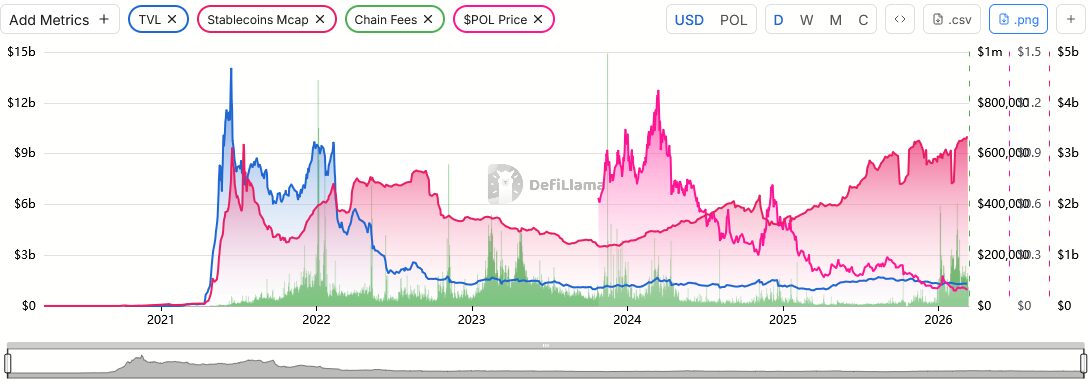
However, this could be explained by the USDC dominance on the $3.36 billion market cap for Polygon, a figure three times bigger than the non-stablecoin related Polygon TVL. Right now, POL has $1.37 billion in total value locked (TVL) on-chain – a massive drop from the $13.25 billion TVL record hit in 2021.
Dig into DailyCoin’s popular crypto scoops today:
Bybit Introduces AI Trading Skills for Natural-Language Crypto Trades
Pi’s Price Jumps 31% On Kraken Listing, But Sales Shadow Pi Day
People Also Ask:
Yes, Polygon is officially listed as one of the partners. Their blog and Mastercard’s announcement highlight it, emphasizing Polygon’s role in providing fast, low-cost settlement for stablecoin payments via their Open Money Stack framework.
The ecosystem is showing strong growth: Polygon’s stablecoin market cap is around $3.38 billion right now (up about 2% in the last week and 9% over 30 days, with USDC at ~51% dominance).
It’s positive long-term—Mastercard’s involvement validates Polygon’s infrastructure and could drive more institutional, as well as regulatory-compliant stablecoin activity.
DailyCoin’s Vibe Check: Which way are you leaning towards after reading this article?
The content published on Finance Insider Today is for informational and educational purposes only. It does not constitute financial advice, investment advice, or any other form of professional advice. Always conduct your own research and consult a qualified financial advisor before making any investment decisions. Finance Insider Today is not responsible for any financial losses resulting from decisions made based on information published on this website. Past performance is not indicative of future results. Financial markets carry significant risk. Never invest more than you can afford to lose.
