
When individuals describe Rutherford Chang’s work, you hear phrases like: obsessive, conceptual, minimalist. These descriptions aren’t incorrect, they level to one thing actual in his observe. However additionally they miss what makes his method distinctive. Chang labored with objects that industrial tradition designed to be an identical: data pressed in tens of millions of copies, portraits drawn in line with strict home type, cash minted for excellent interchange. His curiosity lay within the exact second when the promise of sameness begins to fail, when time and human dealing with depart marks that rework supposedly an identical objects into singular issues.
The retrospective Rutherford Chang: Hundreds and Thousands opened January 17, 2026 at UCCA Middle for Up to date Artwork in Beijing, certainly one of China’s main establishments for modern artwork. This exhibition is critical for a number of causes. It represents Chang’s first institutional retrospective and his most complete solo presentation up to now. It’s also a posthumous one. Chang died in 2025 on the age of 45, abandoning a physique of labor constructed nearly solely across the observe of amassing and arranging mass-produced objects till their particular person histories turned seen and legible.
Beijing gives a becoming location for this retrospective, although not for the apparent causes alone. Sure, Chang moved incessantly between New York and China all through his profession, and sure, he confirmed work in Beijing early on. However the metropolis itself gives one thing extra particular: a context formed by speedy cycles of development and alternative, by the fixed acceleration of change and circulation. In such an setting, Chang’s affected person consideration to what will get left behind, to the residues and traces that accumulate on objects at the same time as they transfer by programs designed to maintain them uniform, takes on explicit resonance. The exhibition is co-curated by Philip Tinari, director of UCCA, and Aki Sasamoto, a fellow artist – each longtime pals of Chang who perceive his working strategies from the within. Their collaboration retains the exhibition near the work as observe, with course of and methodology within the foreground.
To know Chang’s method, we have to look fastidiously on the exhibition’s title. Lots of and 1000’s feels like easy measurement, like a gesture towards quantification. Chang usually labored at scale. He collected not dozens however a whole lot or 1000’s of examples. However what the title actually describes is a technique and a specific method of working that emerges while you interact with mass-produced objects at adequate quantity. Chang found that amount, at a sure level, stops behaving in predictable methods. At a sure scale, repetition begins to disclose element. Put a whole lot of almost an identical objects subsequent to one another and also you begin to see time. You begin to see contact. You see accidents. You see storage. You see neglect. You additionally see care. The marks of particular person dealing with grow to be seen. What you’re , finally, is a report of lived life pressed into objects that industrial tradition designed to maintain steady and interchangeable.
We Purchase White Albums
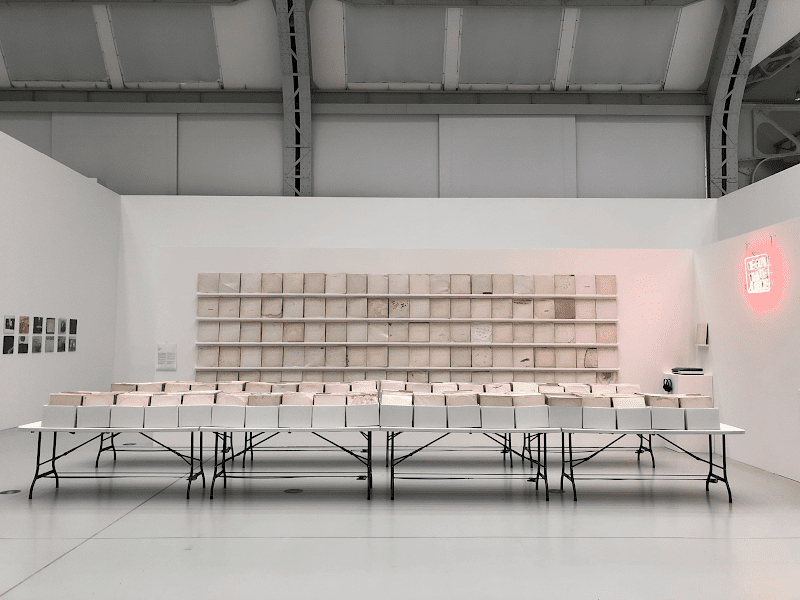
One among Chang’s best-known tasks demonstrates this methodology with explicit readability. We Purchase White Albums operates from a constraint easy sufficient to state in a single sentence, although its implications unfold over years: Chang established a report retailer that stocked solely first pressings of the Beatles’ The Beatles (1968), generally often called “The White Album”. The shop had one rule that inverted regular business logic: It offered nothing, it solely purchased.
This premise is intentionally slim, and it stays slim all through the venture’s length, which seems to be a part of what permits it to scale so successfully over time. Throughout exhibitions the place Chang was current, the work functioned in actual time: individuals might present up with their very own copy of the White Album and promote it to the archive whereas the exhibition was on view. The act of shopping for turned a second of direct change between the work and its viewers, and the archive grew by these particular person transactions as an alternative of curatorial choice or market acquisition. Every copy arrived already marked by years of dealing with. These marks, the collected proof of circulation, carried the work ahead.
To know why this venture works because it does, we have to look extra fastidiously on the White Album itself as an object. Richard Hamilton designed the quilt as an nearly utterly clean white floor. Minimalism at its most reductive type. And but early pressings carry a stamped serial quantity, a small element that complicates the obvious simplicity. This serial quantity performs a curious double perform: it frames every copy as one amongst many (your copy is quantity 0234561 out of tens of millions), whereas concurrently gesturing towards one thing like restricted version standing by the very act of numbering. Right here we discover the contradiction constructed straight into the article itself: mass-produced minimalism making a paradoxical declare to uniqueness. The serial quantity tells you this is only one copy out of tens of millions, whereas the clean white cowl invitations you to make it yours.
Chang understood what this contradiction units in movement as soon as these objects enter circulation and start transferring by time. The clear white floor that Hamilton designed with such care doesn’t keep clear for lengthy. On a regular basis life rewrites it. Water harm spreads throughout the cardboard in irregular patterns. Corners get torn or bent by careless dealing with or too-tight shelving. House owners write their names on the quilt, add notes about when and the place they purchased the album, generally embody dedications or detailed lists of favourite tracks. Value stickers from second-hand outlets accumulate in layers, creating unintended collages of business historical past. In some circumstances, mildew units in throughout storage in damp basements or attics, creating natural patterns that may look nearly intentional, or let’s imagine, nearly inventive. Via all of this, the album stops being a uniform industrial product and turns into one thing singular, that’s marked by its explicit historical past.
The choice to gather these albums in any situation and never looking out just for pristine, museum-quality copies, represents a alternative with vital penalties for the way the work means. It means treating harm and put on as data and never as degradation to be corrected or restored. This shift in how we worth objects is essential to understanding the venture. A pristine copy would possibly inform you one thing about cautious preservation, about somebody who valued the article sufficient to maintain it shielded from the world. However a tattered copy, lined in stains and marks, tells a unique and doubtless richer story. In Chang’s palms, these marks stay seen and start to matter in new methods. He returns time and again, throughout totally different tasks, to this exact level the place objects designed for excellent interchange begin to fray on the edges, the place they start to hold their very own report of circulation that makes them individually readable.
The work doesn’t cease with bodily assortment, nevertheless. Chang took the venture a step additional by recording a number of copies of the album and layering them right into a single audio piece. One hundred versions of the White Album play concurrently, drifting progressively out of sync as small variations in high quality and collected put on compound right into a shifting refrain of sound. The consequence doesn’t register as a remix or a mashup in any standard sense. It feels nearer to the archive itself made audible, a method of listening to how uniformity fails while you stack sufficient iterations on prime of one another. What involves the floor is just not purity or constancy to an unique, however time itself, materialized within the type of friction and noise. The piece features as what we would name materials reminiscence, with surprisingly little curiosity in fan tradition, or the mythology that usually surrounds The Beatles.
The Class of 2008
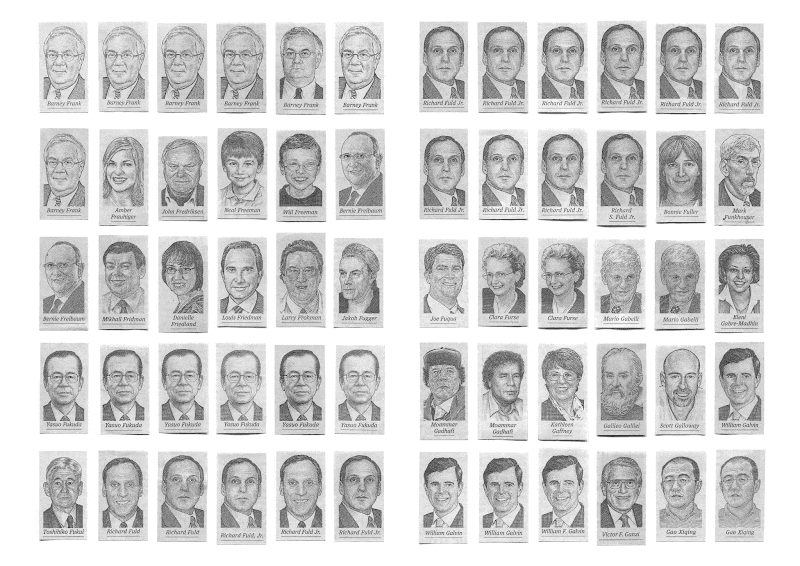
Chang utilized this identical primary methodological method to a really totally different sort of mass-produced object: printed information media. The Class of 2008 presents itself as a simple catalogue. It’s an alphabetical itemizing of each hedcut portrait printed in The Wall Avenue Journal through the 12 months 2008. Earlier than we are able to perceive what Chang does with this materials, although, we have to perceive what hedcuts are and why they matter. Hedcuts are the distinctive stippled, engraving-style portraits that the Journal makes use of for sure figures in its reporting. The approach is borrowed intentionally from nineteenth-century engraving, and it carries with it particular associations: authority, permanence, trustworthiness, the visible register of one thing meant to carry up below scrutiny and stand the check of time.
The construction of {the catalogue} is deceptively easy: alphabetical order, with repetition stored seen within the report. If somebody appeared a number of occasions in 2008, that is clearly indicated within the e-book, and people appearances are explicitly not decreased to a single consultant entry. This choice about how you can set up the fabric issues, as a result of it permits patterns of repetition and recurrence to emerge by the reader’s encounter with the work. And the timing of the venture sharpens its implications significantly. 2008 was, after all as everyone knows, the 12 months when monetary authority got here below extraordinary pressure, when financial constructions that had appeared most steady revealed themselves to be fragile and even illusory. And but all through this era, the visible language of legitimacy within the Journal continued with out interruption, day after day rendering sure faces on this explicit register of authority and belief.
Chang’s catalogue merely data this continuity with out including editorial commentary or express critique. The alphabetical group flattens any narrative arc that the 12 months’s occasions would possibly recommend. There’s no chronological story being instructed about disaster and response, no hierarchy of significance imposed by the order of presentation. As an alternative, repetition itself does the interpretive work. As you web page by the e-book, you discover who seems as soon as and who seems time and again and once more. You begin to see patterns in who will get rendered on this authoritative visible register and who stays exterior it. The hedcut turns into not only a impartial strategy of illustration however a query about legitimacy and illustration: who will get marked as price this explicit sort of consideration, who will get enrolled on this visible vocabulary of permanence and authority, and who stays invisible to this institutional gaze?
Sport Boy Tetris
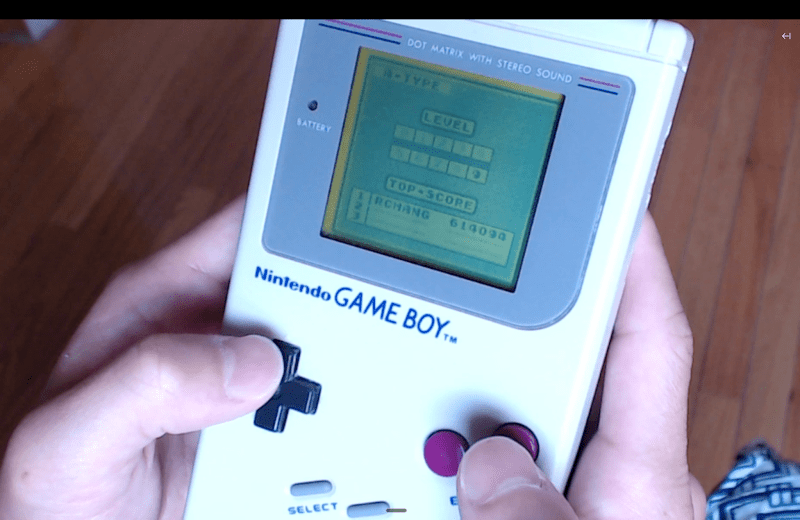
If Chang’s amassing tasks make time seen by the gradual accumulation of marks on bodily objects, Sport Boy Tetris approaches the query of time and repetition by a unique medium: labor itself, because the repetitive effort of attempting and failing and attempting once more. The work paperwork Chang’s repeated makes an attempt to attain the best attainable rating within the unique Sport Boy model of Tetris, filming the method over an prolonged interval till the buildup of makes an attempt turns into the substance and which means of the work. At one level throughout this prolonged engagement, he surpassed Steve Wozniak’s rating on the leaderboard. A element he famous with evident satisfaction –– a reminder of how severely he took questions of record-keeping and documented proof of accomplishment.
The identical easy rule-based system holds your consideration by lengthy stretches of focus punctuated by failure and the choice to restart. The need for completion, for reaching some definitive endpoint, retains pulling you again into the loop at the same time as the explanations for persevering with grow to be more durable to articulate. Progress stays measurable all through — you possibly can monitor enchancment throughout makes an attempt, watch expertise growing and patterns rising — even because the bigger which means or objective of this progress begins to slide away, even because the query of why this explicit rating issues turns into more and more tough to reply with any conviction.
Chang wasn’t observing obsessive cultures or completionist practices from a protected crucial distance, making work about amassing or repetition with out genuinely taking part in these constructions himself. As an alternative, he constructed programs and constraints that would take in years of his personal consideration and energy whereas nonetheless persevering with to demand extra. Over time, by this sustained and real engagement with repetitive constructions, Chang himself begins to resemble the factor he’s ostensibly learning. He turns into, in an actual sense, a sort of repetitive system himself as lived observe.
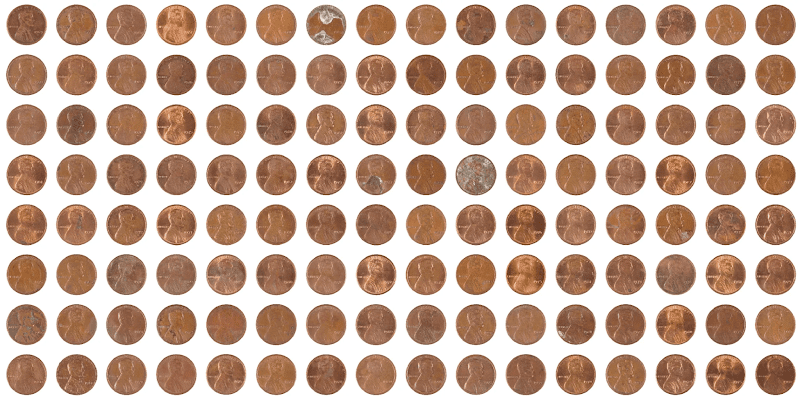
CENTS
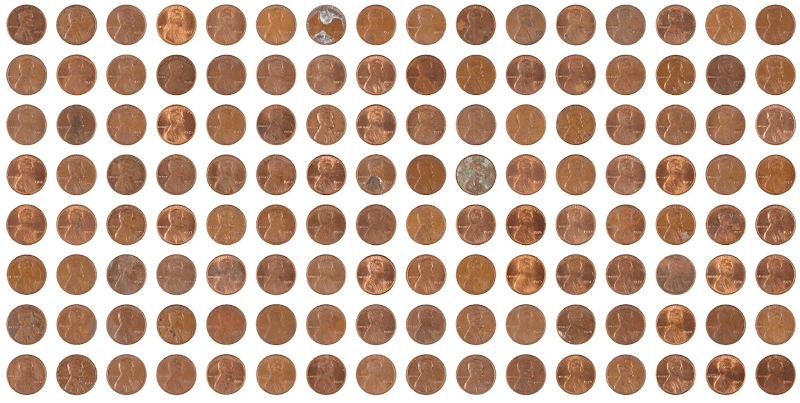
Chang’s last main venture takes his long-standing curiosity in models, requirements, and programs of record-keeping and extends it into what has grow to be an ongoing and in some methods autonomous situation. He accomplished the bodily assortment and documentation of ten thousand copper cents in 2023, at a second when the one-cent coin was nonetheless in common circulation all through america. In 2024 the digital data of those ten thousand particular person cash had been inscribed onto Bitcoin, permitting the work to proceed circulating and accumulating which means past Chang’s direct management or intervention. Then, in a growth that provides all the venture an one other historic dimension, the U.S. Mint stopped producing the circulating one-cent coin on November 12, 2025. What this implies is that in hindsight, with the angle that historic distance gives, the penny itself has begun to learn as a historic object, one thing that belongs to a specific second of foreign money and change that’s now passing into the previous.
The venture begins, like most of Chang’s work, from a situation that many individuals vaguely learn about however not often assume by with any care or precision. Chang restricted his assortment particularly to cents minted earlier than 1982, the 12 months when the U.S. Mint modified the composition of the penny to scale back prices. Earlier than 1982, pennies had been made primarily of copper; after that date, they turned copper-plated zinc. This seemingly minor element has actual penalties: pennies from the ancient times can, below sure market situations, exceed their face worth when thought-about purely as uncooked materials. The copper content material is perhaps price multiple cent. This creates an odd state of affairs the place the State continues to outline every coin as being price precisely one cent (and makes melting them for his or her steel content material unlawful), whereas the fabric actuality of the article suggests a unique worth solely. Chang doesn’t deal with this as a paradox to resolve or an issue to unravel. He treats it as a given, as one of many structural situations that makes the work attainable and fascinating.
The method he developed is methodical and systematic. He eliminated ten thousand copper cents from circulation, pulling them out of the movement of change and use, and documented each individually by detailed images (obverse and reverse, higher often called heads and tails). The cash had been then smelted collectively right into a single copper block weighing sixty-eight kilos. At this second, particular person models disappear solely into undifferentiated mass. The penny’s unusual position in change, its perform as a discrete unit of worth that may flow into and mix with different models, involves a definitive finish. However the block itself continues to exist in a number of kinds. It was rendered as an in depth 3D digital mannequin and inscribed as a single large inscription filling the whole lot of Bitcoin block #839969. This digital model was then sold at Christie’s in 2024, getting into one more system of worth and circulation, transferring from materials object to digital report to collectible art work within the modern artwork market.
The documentation, in the meantime, strikes in the other way from this consolidation. Whereas the bodily cash condense right into a single unified object and lose their existence as separable, countable models, every particular person cent stays readable as a definite report. The photographic photographs keep separate and individuated, each assigned to a set and everlasting place within the set by inscription onto particular person satoshis. What disappears utterly on the degree of fabric type — you possibly can now not maintain these explicit ten thousand pennies in your hand, can now not type by them or organize them or put them again into circulation — stays completely intact on the degree of the report. You may nonetheless take a look at the {photograph} of every particular coin, nonetheless study the actual put on patterns and floor marks and small imperfections that distinguished it from the 9 thousand 9 hundred and ninety-nine others.
This construction permits CENTS to carry in pressure a number of totally different and doubtlessly conflicting concepts about the place worth is situated and the way it will get established and maintained. There’s worth as outlined by governmental authority: the State declares that this coin is price one cent, and that declaration carries authorized power. There’s worth registered in materials composition: the copper content material would possibly really be price multiple cent when calculated in line with commodity costs. And there’s worth produced by preservation and documentation: the choice to {photograph} every coin individually, to keep up the archive’s legibility over time, to deal with these mass-produced objects as worthy of sustained consideration. These totally different registers of worth stay distinct inside the work, not collapsing right into a single unified which means or resolving into some synthesis.
After we place CENTS alongside We Purchase White Albums and take into consideration them as a part of a constant observe, the underlying logic turns into clear. Objects that had been designed and manufactured for excellent interchange, for being functionally an identical and mutually substitutable, grow to be readable as singular and particular person as soon as their circulation is interrupted and held nonetheless, as soon as their explicit histories are made seen by cautious documentation and systematic archiving.
It’s price noting right here — as a result of it issues for understanding how the work continues to perform after Chang’s dying — that CENTS was initiated by collaboration with Sovrn Art, an unbiased, artist-first platform that supplied the preliminary framework and assist for the venture’s growth. After the complete inscription of the work onto Bitcoin was accomplished, a council shaped independently of Chang himself, with out his group or oversight. This council is made up of collectors who selected, for their very own causes, to take accountability for the work’s continuation and interpretation. The council members come from totally different generations and totally different skilled fields, bringing varied types of experience and perspective to their engagement with the archive. Their work has centered persistently on protecting the distinctions inside the archive seen and legible — by shut studying of the documentation, by cautious cataloguing of variations and patterns, by writing that approaches the fabric from a number of angles and asks totally different sorts of questions. Their involvement has centered significantly on the issue of how you can preserve this archive readable and significant over time, how you can preserve the precision and care of the report because it continues to flow into by programs and contexts that Chang himself couldn’t have anticipated.
Archive as Follow
It’s straightforward to name Rutherford obsessive. The sustained consideration over years, the dedication to completeness and thoroughness, the willingness to spend huge quantities of effort and time on tasks constructed round intentionally slim constraints. The phrase isn’t inaccurate. And but it nonetheless manages to overlook one thing necessary concerning the dimension of what Chang was really doing along with his time and a focus. He handled mass tradition and industrial manufacturing with a sort of persistence that’s uncommon in modern artwork. He made rarity and singularity seen inside exactly these issues we’ve realized to miss or dismiss as generic and interchangeable. He listened fastidiously to what we would name the noise inside acquainted symbols and objects — the small variations and collected marks that circulation and dealing with inscribe on surfaces that had been designed particularly to withstand such marking and stay steady over time.
This consideration to what accumulates within the gaps and margins of programs designed for uniformity helps clarify why Lots of and 1000’s works so successfully as a title for this retrospective. On one degree, it merely names the size at which Chang characteristically labored: amassing not dozens however a whole lot, not a whole lot however 1000’s of examples. Nevertheless it additionally names one thing extra elementary. A self-discipline, a specific sort of methodical observe that requires trying lengthy sufficient and thoroughly sufficient that distinction begins to seem inside what first presents itself as sameness. The observe retains returning, with exceptional consistency throughout totally different tasks and supplies, to what circulation leaves behind: the marks and traces that accumulate even on objects designed to stay steady and unchanged.
Chang’s work will be learn, in some ways, as a sustained observe of custody and care. He stored objects, pulled them out of circulation or gathered them from its margins. He listed and arranged them into programs that made their particular person histories newly seen and legible. After which, crucially, he returned them to circulation in altered type: as archives open to examination, as exhibitions that invited direct encounter, as everlasting data inscribed on Bitcoin. Via this course of, he constructed conditions and constructions by which circulation itself turns into seen as a course of. Wherein worth turns concrete and measurable. The archive is persistently the place this transformation takes place in his work — the location and the tactic by which particular person objects grow to be readable as elements of bigger programs and patterns.
The retrospective gathers Chang’s methodology right into a single body and brings collectively tasks from totally different moments in his profession to display the underlying consistency of his method throughout varied supplies and contexts. What stays is the construction he constructed, the archives he assembled with such care, the questions he persistently refused to resolve or shut down prematurely. The promise of sameness retains failing. Distinction retains showing within the gaps and variations. The marks keep seen for anybody keen to look intently sufficient, and patiently sufficient, to truly see them.
It is a visitor publish by Steven Reiss. Opinions expressed are solely their very own and don’t essentially mirror these of BTC Inc or Bitcoin Journal.
The content published on Finance Insider Today is for informational and educational purposes only. It does not constitute financial advice, investment advice, or any other form of professional advice. Always conduct your own research and consult a qualified financial advisor before making any investment decisions. Finance Insider Today is not responsible for any financial losses resulting from decisions made based on information published on this website. Past performance is not indicative of future results. Financial markets carry significant risk. Never invest more than you can afford to lose.
